

How to Build Puppy Confidence in Real Life
- Aug 14
- 6 min read
A puppy who freezes at the kerb, panics when a lorry passes or launches at every dog is not being difficult. They are telling you that the situation is bigger than their current ability to cope. The aim when you build puppy confidence is not to create a puppy that rushes up to everything without hesitation. It is to raise a dog that can notice everyday life, stay composed and look to you for direction.
That matters long after the puppy stage. A confident dog is usually easier to walk, more able to learn around distractions and less likely to make fearful choices when life gets busy. Confidence supports recall, loose-lead walking, calm greetings and the ability to settle when nothing exciting is happening.
What puppy confidence really looks like
Confidence is often mistaken for boldness. The loud puppy who charges towards people, pulls to greet every dog and steals food from the table may look fearless, but they may simply have poor impulse control. Equally, a quiet puppy is not automatically anxious.
What you are looking for is recovery and resilience. A confident puppy may startle at a dropped pan, then investigate from a sensible distance and carry on. They may be unsure around a new person, but they can take information from you rather than spiralling into panic. They do not need to love every experience. They need to learn that unfamiliar things can be handled calmly.
This is why forced socialisation causes so many problems. Being passed around by strangers, taken into crowded shops, or pushed towards dogs they do not want to meet can teach a puppy that they have no control. Exposure is useful only when it is managed at a level the puppy can cope with.
Start with safety, routine and clear communication
Puppies gain confidence when their world makes sense. A predictable routine for meals, sleep, toilet breaks, play and quiet time reduces unnecessary stress. Most young puppies need far more rest than owners expect. An overtired puppy can become bitey, frantic, sensitive to sounds and unable to take in training.
At home, calmly teach the basics that give your puppy a framework: their name, coming when called, settling on a bed, walking with you on a loose lead and giving up an item when asked. Use food, toys and praise to make good choices worthwhile, then back that up with fair, consistent boundaries. If jumping up earns attention one day and is ignored the next, the puppy receives mixed information.
Clarity is not harshness. It is kind. Your puppy should understand what earns access to the sofa, a greeting, a game or the front door opening. When you guide those moments consistently, they learn that listening to you works.
Build puppy confidence one small challenge at a time
The best confidence work is usually boring to anyone watching. It happens in short, successful sessions, not in one huge outing designed to tire the puppy out.
Choose one new thing and give your puppy enough distance to observe it without becoming overwhelmed. That could be a cyclist on the other side of the path, children playing behind a fence, traffic heard from a quiet side street or a person carrying an umbrella. Let them look. Mark and reward calm behaviour, then move away before they feel they have to react.
If your puppy will not take food, pulls away, stares intensely, crouches, barks or cannot respond to their name, the challenge is too difficult. Increase distance, reduce the duration or pick an easier location. Progress is not measured by how close you can get. It is measured by how calmly your puppy can process what is happening.
For some puppies, confidence grows quickly. For others, especially those with a cautious temperament or a difficult early start, it needs patient repetition over weeks and months. Pushing the pace may create a setback, while a steady approach builds durable behaviour.
Let your puppy investigate without taking over the walk
Safe exploration is valuable. Allow time to sniff different surfaces, step over a shallow drain cover, walk across grass, gravel and paving, and investigate a bench or fallen branch. These small experiences teach body awareness and problem-solving.
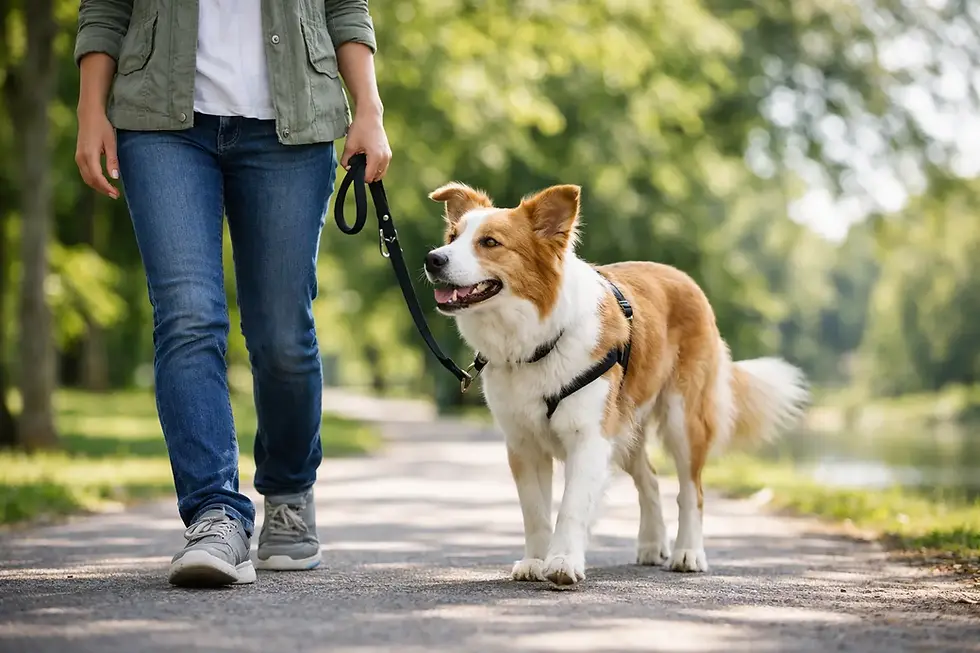
However, exploration should not mean the puppy drags you from scent to scent or decides every direction. Keep the lead loose, move together and use short releases to allow sniffing as a reward for checking in with you. This creates a useful balance: your puppy has room to be a dog, while you remain the calm decision-maker.
Avoid turning every walk into a training test. A few minutes of focused practice, followed by relaxed sniffing and quiet observation, is often more productive than an overstimulating hour outdoors.
Be selective about people and dog greetings
Your puppy does not need to greet everybody. In fact, teaching them that people and dogs can pass by without interaction is one of the most useful lessons you can give them.
Choose a small number of calm, dog-aware people for positive greetings. Ask them to stand sideways, avoid looming over the puppy and let the puppy approach at their own pace. If the puppy hangs back, do not coax them forward with a stranger's hand full of treats. Give them space and reward their choice to stay calm near the person instead.
The same applies to dogs. A well-matched, steady adult dog can teach far more than a chaotic group of excited puppies. Avoid on-lead greetings with unknown dogs where possible. Leads restrict movement, and even friendly dogs can become tense when they cannot move away naturally. Your goal is neutrality: your puppy sees another dog and stays connected to you.
Teach recovery after a scare
No matter how carefully you plan, something will surprise your puppy. A bin lorry may appear around a corner, a gate may slam, or a dog may bark behind a hedge. The key is what happens next.
Do not fuss excessively or rush your puppy straight towards the thing that frightened them. Create distance, keep your own body language calm and give them a simple, familiar task such as hand target, name response or walking with you for a few steps. Reward when they re-engage. Then decide whether they are ready to watch from a safer distance or whether it is better to leave.
Your calm response gives the puppy useful information: something unexpected happened, but their handler has it covered. Repeated experiences of recovering well are how confidence is built.
Confidence needs boundaries as well as encouragement
A common mistake is allowing nervous behaviour to dictate every decision. If a puppy is worried by a new doorway, for example, giving them a moment to assess it is sensible. Ending the outing and retreating every time they hesitate can unintentionally teach avoidance as the default answer.
The balance is to offer support without pressure. Reduce the task, use gentle encouragement and reward an achievable step forward. If the puppy cannot cope, make the environment easier rather than insisting. A puppy that learns to work through manageable uncertainty becomes more capable than one who is either forced through fear or constantly rescued from it.
This is also where consistent lead handling matters. Keep the lead loose where it is safe, avoid tightening it in anticipation of trouble and do not allow frantic pulling to take your puppy closer to what they are worried about. Your handling should say, clearly, that you are present and in control.
Practise confidence in the places that matter
Kitchen training has its place, but real life happens on pavements, in parks, near school gates, outside cafés and around the visitors who come to your home. Once your puppy understands a skill in a quiet setting, practise it gradually in more realistic environments.
Start with short visits at quieter times. Work at a distance from distractions and leave while your puppy is still successful. A five-minute session near a busy path, where your puppy can watch people pass and remain calm, is often more valuable than a long walk that ends in overload.
For owners in Crawley and the surrounding West Sussex area, this may mean using quieter residential routes before moving towards busier parks or town-centre environments. Build the skill before testing it. That is how calm, reliable behaviour becomes dependable outside the training session.
When extra support is the right choice
Some concerns need professional input early. Seek help if your puppy repeatedly hides, freezes, growls, snaps, panics at normal household or outdoor sounds, or cannot recover after being startled. Sudden changes in confidence also warrant a veterinary check, as pain or illness can affect behaviour.
Getting support is not an admission that you have failed. It is often the quickest route to a clear plan before worry becomes a well-rehearsed habit. A good trainer will assess the puppy in context, coach your handling and give you practical work that fits family life.
Your puppy does not need a packed social calendar or constant entertainment to become confident. They need steady guidance, well-chosen experiences and the chance to learn that the world is manageable with you beside them. Keep the steps small, be consistent, and let every calm recovery become proof that they can cope.


Comments