

How to Use a Recall Training Leash
- Jun 9
- 6 min read
A recall training leash is often the difference between hoping your dog comes back and knowing you have a safe way to teach it properly. If your dog ignores you in the park, charges over to other dogs, or treats coming back as optional, the problem is rarely stubbornness alone. More often, the training has not yet been clear enough, consistent enough, or proofed well enough around real distractions.
That is exactly where a long line earns its place. Used well, it gives your dog freedom to move while keeping you in control of the outcome. Used badly, it becomes just another bit of kit attached to patchy training. The leash itself is not the solution. It is a tool that lets you teach recall in a fair, structured, practical way.
What a recall training leash actually does
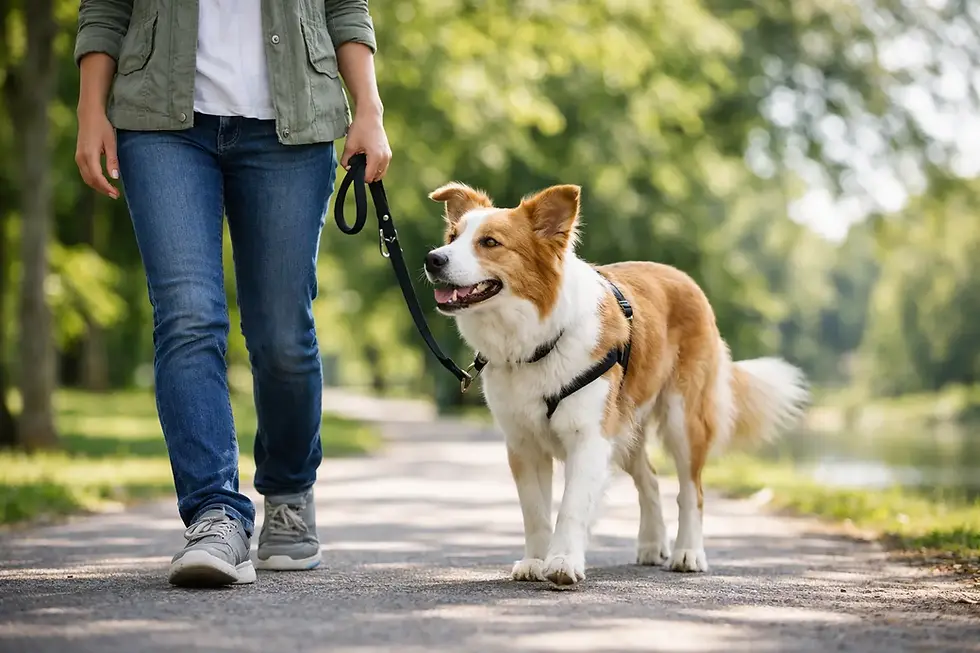
A recall training leash, usually a long line, creates a safe middle ground between a short lead and true off-lead freedom. Your dog can explore, sniff and move ahead, but not disappear into the distance rehearsing the wrong behaviour. That matters because every time your dog learns they can ignore the recall cue, the habit becomes stronger.
Good recall training is not about shouting louder or repeating your cue ten times. It is about building a pattern your dog understands. Hear the cue, turn back, return promptly, and good things happen. The line helps you protect that pattern while the behaviour is still being learned.
For many family dogs, especially adolescents, rescue dogs and highly social dogs, this stage is essential. They may know their name in the kitchen and still switch you off completely in a field. That is not unusual. It simply means the training has to be built where real life happens.
Choosing the right recall training leash
Not every long line is practical for every dog. Length, material and handling all matter. In most cases, a line of around 5 to 10 metres works well for early recall work. Shorter can feel too restrictive. Much longer can be difficult to manage unless your handling is tidy and your environment is suitable.
Biothane-style lines are popular because they are easier to clean and less likely to soak up water and mud. Fabric lines can work perfectly well too, but they become heavy and messy quickly in poor weather. If you are training in open fields around West Sussex through autumn and winter, that is worth thinking about.
Avoid anything with too much weight for a small dog, and be cautious with very thin lines that can burn your hands. Gloves can help, especially if your dog is fast or likely to hit the end of the line with force.
A harness is often the safer option for recall work on a long line, particularly for dogs who lunge suddenly. Clipping a long line to a flat collar can create too much pressure on the neck if the dog reaches the end at speed.
How to start using a recall training leash
The first mistake many owners make is waiting until the dog is fully distracted before using the recall cue. Start where you have a realistic chance of success. That might be the garden, a quiet green space, or a calm corner of the park before the footballs, squirrels and other dogs appear.
Let your dog move out on the line without keeping constant tension. The goal is not to drag them around on a long lead. It is to allow freedom while you stay connected. Watch for moments when your dog is mildly occupied but still mentally available, then use your recall cue once.
When your dog turns and commits to coming back, reinforce it properly. That may mean food, praise, a toy, or being released back to sniff. The reward needs to matter to the dog in that moment. For some dogs, one dry biscuit in a high-distraction field is simply not enough.
If your dog hesitates or starts to ignore you, this is where the line helps. You do not haul them in. You use calm, steady guidance to prevent the full rehearsal of ignoring you, then reward once they complete the return. The point is clarity, not force.
The biggest mistakes owners make
One of the most common problems is only calling the dog when it is time to go home. Dogs learn patterns quickly. If recall always ends the fun, many dogs will start avoiding it. Call them back at random points, reward well, then send them off again.
Another issue is repeating the cue. If you say the recall word over and over while your dog carries on doing their own thing, you teach them that the first few repetitions do not matter. Use the cue once, then follow through with the line if needed.
Timing is another big one. Owners often wait until the dog is already charging towards another dog or locked onto something more exciting. At that point, you are competing with momentum and adrenaline. Better recall work happens earlier, when you spot the distraction before your dog is fully committed to it.
Then there is inconsistency. Some days the dog is expected to come back straight away, other days they are allowed to ignore the cue three times. Dogs do better when the rules are clear. Reliable behaviour comes from reliable handling.
Building recall beyond the leash
The recall training leash is a bridge, not the final goal. Once your dog is responding consistently on the line, you begin to test the behaviour with more distance, more environmental challenge and less reliance on physical backup.
That does not mean unclipping the line too early and hoping for the best. It means progressing in stages. You might let the line drag in a safe area before removing it altogether. You might practise around one distraction at a time rather than adding everything at once.
This is where many owners rush. The dog has had three good recalls in one field, so they assume the job is done. Then they go to a busier park, unclip, and the dog vanishes towards the nearest spaniel. Recall is context-dependent. Dogs do not generalise as neatly as people expect. If they can do it in one place, that is a good start, not proof of reliability everywhere.
When a recall training leash is not enough on its own
Some dogs need more than better mechanics. If your dog has a long history of running off, is highly reactive, becomes over-aroused outdoors, or has learned that other dogs are more rewarding than you, the issue is not just recall. It is the overall picture.
A dog that is frantic, over-social or constantly scanning the environment is harder to call away because their state of mind is already working against you. In those cases, recall improves when you also address neutrality, engagement, lead skills and impulse control.
That is why balanced, real-world training matters. You can reward heavily and still set fair boundaries. You can build motivation and still expect follow-through. For most family dogs, that combination creates behaviour that holds up outside the training session rather than falling apart the moment life gets interesting.
Making recall work in real life
The best recall is not the one that works in a perfect training set-up. It is the one that works when your dog spots a jogger, another dog appears from behind a hedge, or a good smell pulls them off task. Real-life results come from practising in real-life conditions, without skipping the foundation.
Use your long line in a way that keeps both safety and learning in place. Stay aware of the environment. Avoid letting the line wrap around legs, dogs or trees. Do not use it in crowded spaces where it creates a hazard. And do not measure progress purely by whether your dog comes back once. Look at how quickly they respond, how much prompting they need, and whether the behaviour is improving across different settings.
If you are struggling, it is often not because your dog cannot learn. It is because the steps have been too big, the rewards too weak, or the expectations unclear. That is fixable.
For owners who want calm, reliable behaviour rather than crossed fingers at the park gate, a recall training leash is one of the most useful tools you can own. It gives you a way to train with structure, protect your cue, and build freedom properly. Give the process the time it deserves, and your dog starts to earn the sort of trust that makes everyday walks feel easy again.


Comments