
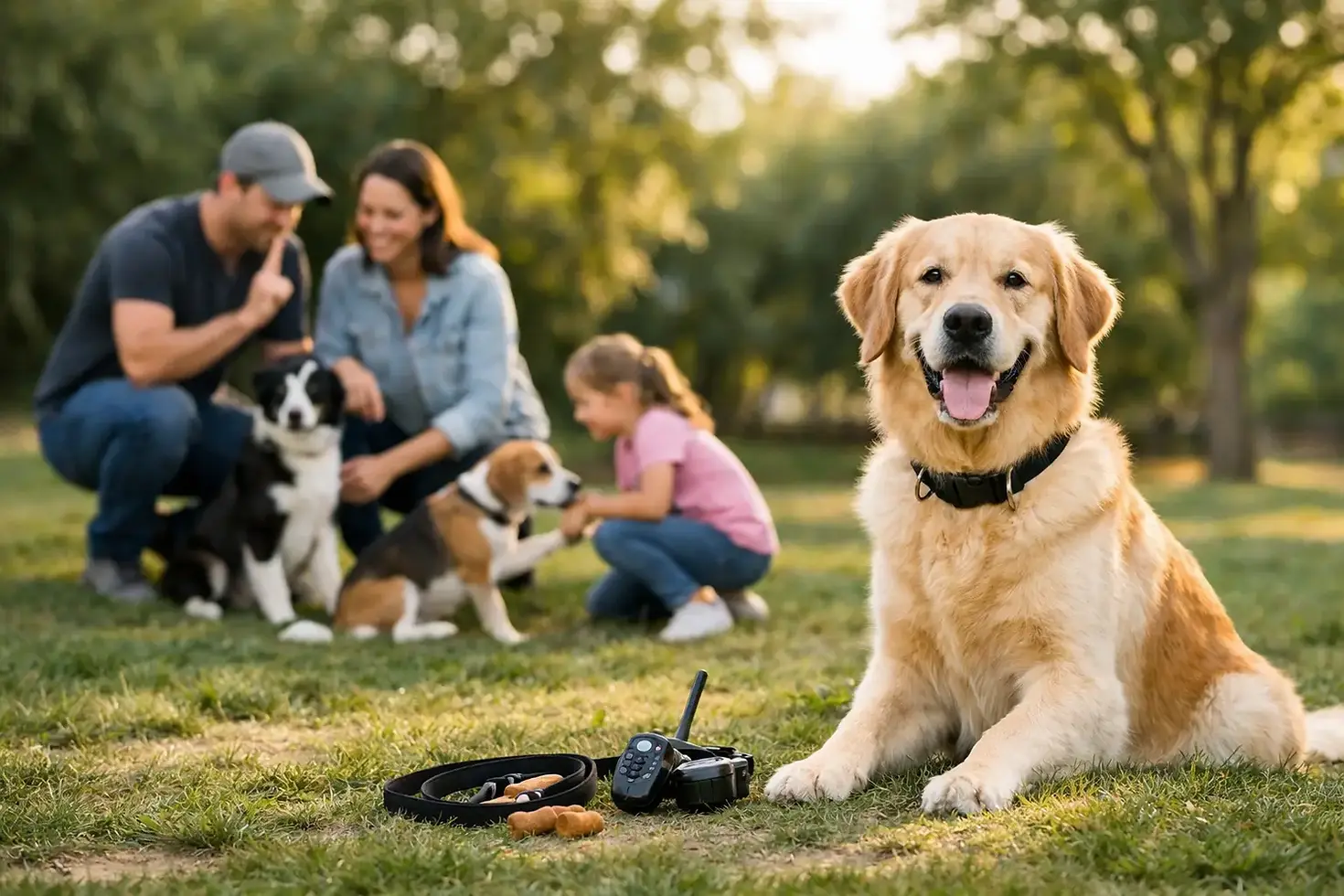
Balanced Training for Family Dogs That Works
Your dog may sit beautifully in the kitchen, then ignore you completely at the park. They may take treats in a quiet lane but drag you towards every dog they see on a busy pavement. That gap is where balanced training for family dogs earns its place. The aim is not a dog who performs when the food appears. It is a dog who understands what is expected, can cope with everyday distractions and is safe to give more freedom.
For families in Crawley, Horsham, Horley and the surrounding area, real life includes school-run traffic, visitors at the door, children moving about, muddy footpaths and unpredictable dogs in public spaces. Training has to work there, not just in a calm lesson setting. A balanced approach gives owners a practical way to build that reliability without losing the relationship they value with their dog.
What balanced training for family dogs means
Balanced training combines reward-based learning with fair, consistent boundaries. We reward the behaviour we want more of - coming back when called, walking on a loose lead, settling on a bed, checking in around distractions. At the same time, we do not leave the dog guessing when a behaviour is unsafe, rude or repeatedly ignored.
This is not about being harsh, dominating your dog or correcting every small mistake. It is about clear communication. Your dog needs to know when they have made a good choice, what the cue means and what happens when they choose not to follow a known cue. The boundary must be proportionate, timely and taught fairly. A puppy learning to come away from a smell needs guidance and management. A dog that fully understands recall but repeatedly runs across a road requires a more serious level of accountability.
The balance will look different for every dog. A soft, worried dog may need more confidence-building, distance from pressure and carefully planned exposure. A bold adolescent who has learned that pulling gets them everywhere may need firmer structure. Good training is not allegiance to one tool or slogan. It is reading the dog in front of you and choosing the least intrusive approach that creates safe, lasting change.
Why treats alone can stop working outside
Food is useful. It helps create positive associations, makes new exercises clear and gives you a way to reinforce behaviour you like. We use it often, particularly with puppies and when teaching a new skill. The problem begins when treats become the only reason a dog responds.
Outside, the environment can be more rewarding than your pocket. A squirrel, another dog, an open field or a scent trail may carry far more value. If recall has only ever meant "come back for a snack if you feel like it", many dogs will make the obvious choice when excitement rises.
That does not mean you need to stop rewarding your dog. It means rewards become part of a wider system. The dog learns that recall is non-negotiable, then discovers that returning can lead to food, praise, a game, permission to sniff or being released back to play when appropriate. This creates a dog who listens because the cue has meaning, not because they are checking whether the reward is good enough.
Start with clarity before asking for accountability
A common mistake is correcting a dog for failing a cue they have never properly learned. Before you expect reliability around distractions, teach the behaviour in stages. Say the cue once, help the dog succeed, reward the right response and practise until the action is familiar.
Take loose-lead walking. Begin somewhere your dog can concentrate. Reward the lead becoming slack and make forward movement part of the payoff. If they pull, calmly stop or change direction so tension no longer takes them where they want to go. With repetition, the dog learns that staying connected gives them access to the walk.
Then increase the challenge gradually. Move from the garden to a quiet street, then a busier route, then a place where dogs and people pass by. If your dog falls apart at the next stage, that is information, not failure. Reduce the difficulty, improve the setup and build again. Expecting a dog to cope with a crowded park before they can focus on a quiet pavement is unfair to both of you.
The cue should mean one thing
Family homes are busy, and mixed messages are easy to create. One person calls the dog five times before getting up. Another lets them jump at the kitchen counter. Someone else gives attention when the dog barks at the window. The dog is not being stubborn if these rules change from person to person - they are responding to what has worked before.
Choose a small number of useful behaviours and agree how the household will handle them. Recall, place or settle, waiting at doors and loose-lead walking will improve daily life far more than a long list of party tricks. Use the same cue, follow through calmly and reward genuine effort. Consistency is not about being perfect. It is about making your expectations predictable enough for the dog to understand.
Boundaries create freedom, not restriction
Owners sometimes worry that boundaries will make their dog unhappy. In practice, sensible boundaries often reduce conflict and give dogs more access to the world. A dog who can walk past another dog without lunging is welcome on more walks. A dog with a dependable recall can enjoy safe off-lead time. A dog who settles when visitors arrive can remain part of family life rather than being shut away.
Boundaries also protect dogs from rehearsing behaviour that becomes stronger with practice. Every time a dog pulls to greet, raids a worktop, barges through a doorway or ignores recall to chase wildlife, they are learning that the behaviour pays. Management matters while training catches up. Use a lead, long line, stair gate or planned distance where needed. Preventing repeated mistakes is not a shortcut. It is responsible training.
The goal is calm control, not constant control. Your dog should have opportunities to sniff, play, explore and make good choices. Structure simply gives those freedoms a safe framework.
Confidence and neutrality matter as much as obedience
Not every problem is disobedience. Some dogs pull because they are overexcited. Others react because they are worried, frustrated or overwhelmed. A dog barking at every passing dog is not necessarily trying to be difficult. They may be trying to create distance, reach the other dog or cope with pressure they do not know how to handle.
This is where a balanced trainer looks beyond the visible behaviour. You may need to create more space, change walking routes temporarily and teach your dog that seeing a trigger does not require a reaction. Reward calm observation. Build engagement with you. Give clear guidance when they start to escalate, rather than allowing them to practise the full outburst.
Forced greetings are rarely helpful. Your dog does not need to say hello to every person or dog to be sociable. Neutrality is often the more useful goal: noticing the world without needing to control it, chase it or greet it. For a family dog, that skill makes walks quieter and public spaces far less stressful.
What progress really looks like
Progress is not always dramatic. It may be your dog looking at another dog and then back at you. It may be one less pull on the way to the park, a faster response to recall or a calmer welcome when the doorbell goes. These small changes matter because they show the dog is building better habits.
There will also be uneven days. Lack of sleep, visitors, adolescence, a new environment or a stressful encounter can affect behaviour. Do not treat a setback as proof that the training has failed. Return to what your dog can do, lower the difficulty and continue with the same clear rules.
If your dog is showing serious fear, aggression or has a history of biting, do not rely on generic advice alone. Safety management and skilled, individual support are essential. The right plan should protect people and dogs while addressing the reason behind the behaviour.
Train for the life you actually live
The most useful training fits into ordinary routines. Ask for a wait before meals, practise a short settle while you make tea and reward your dog for choosing to relax while the family moves around. On walks, use real moments: pause at kerbs, practise attention before passing someone and call your dog away from low-level distractions before you need them in an emergency.
Keep sessions short enough that you can be consistent. Five focused minutes every day will usually beat one long, frustrated session at the weekend. Be calm, be fair and avoid repeating cues until they lose meaning. If you have asked, help your dog follow through.
A well-trained family dog is not a robot, and they do not need to be. They can be playful, curious and full of character while still responding when it matters. Give them clear communication, worthwhile rewards and boundaries they can understand, and you create the confidence that makes everyday freedom possible.



Comments