
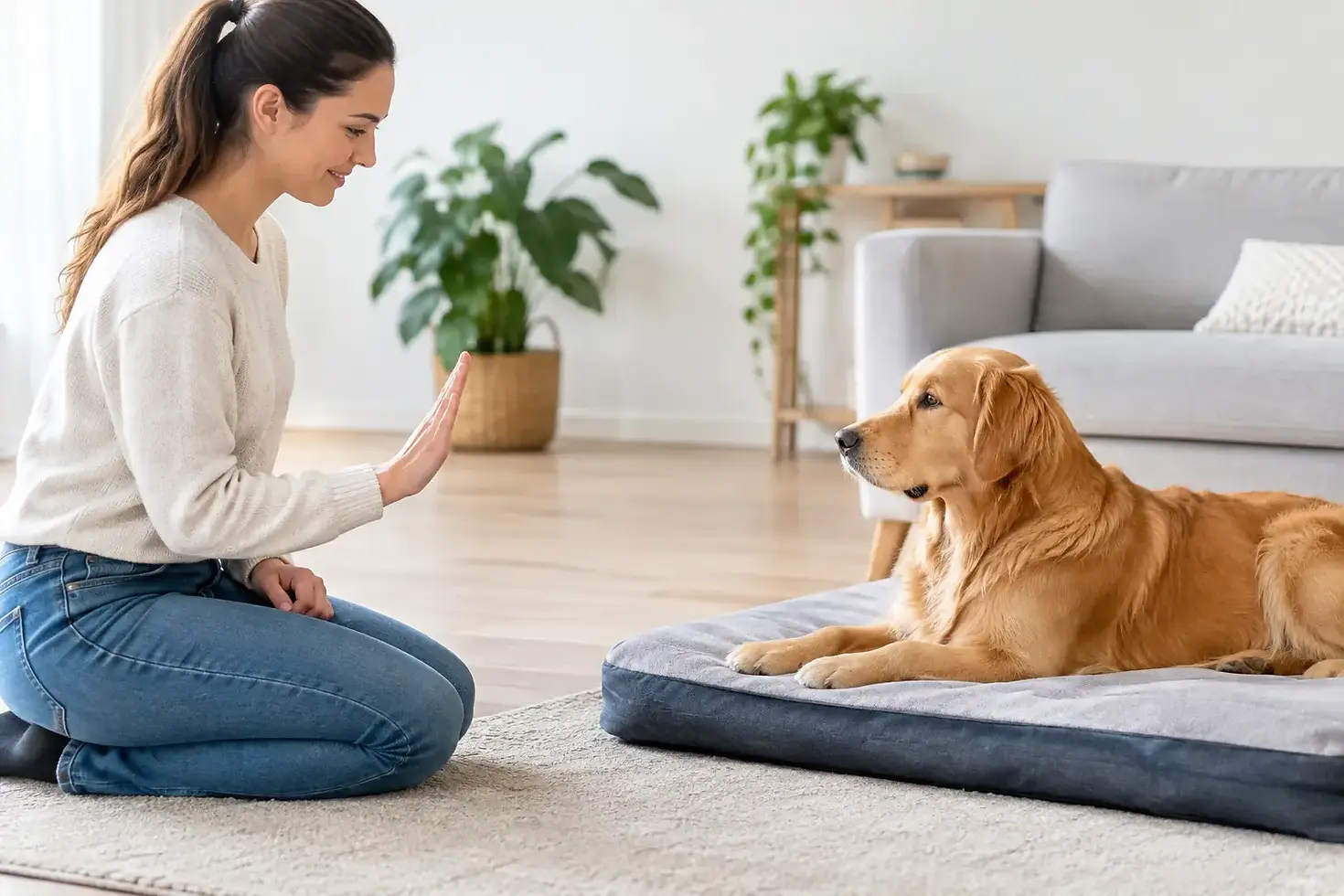
How to Train Your Dog’s Place Cue for Calm
The doorbell rings, someone walks in, and your dog launches towards the hallway before you have even reached the handle. This is where a well-trained place cue earns its keep. When you train your dog’s place cue properly, you are not simply teaching them to lie on a bed. You are giving them a clear job: go to your designated spot, settle there and remain there until released.
For family dogs, that skill can change daily life. It creates calm during meals, stops repeated crowding in the kitchen, gives visitors space to enter, and helps dogs practise switching off when life gets busy. But it only works when the cue is built with clarity, not by repeatedly saying “place” while your dog wanders straight back off the mat.
What a dog place cue should look like
A place cue sends your dog to a defined area - usually a raised bed, a sturdy mat or a platform - where they stay until you give a release word. The surface itself is not the lesson. The lesson is commitment to the space, even when something more interesting is happening elsewhere.
At the beginning, your dog may only hold position for a few seconds. That is normal. The finished behaviour is a dog who can go to their place when asked, settle without constant reminders and wait calmly while you answer the door, prepare dinner or move around the room.
This is different from asking for a quick sit or down. A place cue has duration and distance. Your dog learns that they do not need to follow you from room to room or involve themselves in every household event. For dogs that are overexcited, anxious around visitors or always under your feet, that structure can be genuinely relieving.
Choosing the right place
Use a clearly defined, non-slip surface that is large enough for your dog to stand, sit and lie down comfortably. Raised beds can make the boundary obvious, while a mat is easier to move around the home. Neither is automatically better. Choose the option your dog can use safely and that you will realistically keep available.
Avoid starting with their usual soft bed if they already wander on and off it without direction. A separate training mat or platform often gives the exercise more meaning. Keep it in a low-distraction room at first, away from the front door, food preparation and noisy family activity.
Your release cue matters just as much as the place cue. Choose one word, such as “free”, “break” or “okay”, and use it consistently. Until your dog hears that release word, the expectation is to remain on the place.
How to train a dog place cue step by step
Start by rewarding the right choice
Place the mat on the floor and guide your dog towards it. You can lure them on with a piece of food in the first few repetitions if needed, then mark and reward as soon as all four paws are on the surface. Do not rush to name the behaviour before your dog understands what earns the reward.
Feed several rewards on the mat, low and calmly, so staying there pays. If your dog steps off, simply pause the reward and guide them back on. There is no need for frustration or a big correction. The message is straightforward: rewards happen on the place, not beside it.
Once your dog is confidently stepping on, begin encouraging a sit or down. A down is useful for longer settling, but do not force it too early. Some dogs need time to feel comfortable on a raised surface or unfamiliar mat.
Add the cue when the behaviour is predictable
When your dog is deliberately moving onto the place as soon as you present it, say your chosen cue just before they step on. Say it once, in a calm, clear voice. Then reward the correct response.
This timing matters. Repeating “place, place, place” teaches your dog that the first word has no meaning. Give the cue, allow a moment for them to respond, and help them only if necessary. Over time, reduce the lure so your dog is responding to the word rather than following food.
Build duration before making it difficult
This is where many owners accidentally move too fast. A dog who can run to a mat for a treat has not yet learned to stay there. Begin by rewarding every few seconds while your dog remains settled. Then gradually increase the time between rewards.
Stay close at first. If your dog gets off before being released, calmly guide them back to the place without drama. Reward them again once they are settled. The aim is not to trap them there for long periods. It is to show them that holding position is worthwhile and predictable.
Keep sessions short enough for success. Three good minutes are more valuable than fifteen minutes of your dog repeatedly failing and being put back. Finish with your release cue, then let them move away. The release should feel clear, not accidental.
Add movement, then distance
Once your dog can settle while you stand nearby, introduce small movements. Take one step away, return and reward. Walk around the room. Sit on the sofa. Open a cupboard. The moment your dog starts to struggle, make the exercise easier again.
After that, begin adding distance. Take two steps away, then four. Step briefly out of sight and return before your dog leaves the place. This is not about testing your dog until they fail. It is about building confidence through manageable repetitions.
A long training lead can be useful for some dogs once you begin working around greater distractions. It allows you to prevent rehearsing the habit of leaving without chasing or creating a confrontation. Used fairly, it supports the cue while your dog learns the rules.
Taking the place cue into real life
The real value comes when the cue works outside a quiet training session. Start with predictable household situations. Ask your dog to go to place while you make a cup of tea, fold laundry or sit down for dinner. Reward calm behaviour at intervals, then release them when the activity is finished.
Next, practise before the doorbell becomes a problem. Put your dog on place, then have a family member knock softly or ring the bell. Reward your dog for staying put. Build gradually towards opening the door and allowing a familiar visitor to enter. If your dog is barking, pacing or breaking position repeatedly, the situation is too difficult for their current level. Reduce the challenge rather than trying to outlast the behaviour.
For dogs that become highly aroused when visitors arrive, management is sensible. A baby gate, lead or separate room may still be necessary while training develops. The place cue is not a shortcut around safety, particularly with a dog that is fearful, reactive or has a history of rushing people.
You can also use the cue outdoors, but only after it is reliable at home. A portable mat can help your dog settle at a quiet café table, during a family picnic or while you speak to someone on a walk. Public environments are much harder, so lower your expectations and reward more generously at first.
Common mistakes that weaken the cue
The biggest mistake is using place only when something unpleasant is about to happen. If your dog is sent there exclusively when guests arrive, children are eating or they are being told off, they will begin to avoid it. Build plenty of ordinary, positive repetitions when nothing much is going on.
Another common issue is releasing the dog without saying the release word. If they wander off and nobody guides them back, they learn that staying is optional. Be fair and consistent: either help them back to the place or release them properly.
Finally, do not rely on food forever. Food is valuable for teaching and reinforcing, especially around distractions, but the long-term goal is a dog who understands the cue because it is clear and consistently followed through. Calm praise, access to you and release to normal life can all become part of the reward picture.
When extra support helps
Some dogs find settling difficult because they are overtired, under-exercised, worried by visitors or already used to controlling the household space. In those cases, a place cue should sit within a wider plan that includes suitable exercise, clear boundaries and work on the underlying behaviour.
A young, energetic adolescent may need more help learning impulse control. A reactive dog may need careful distance work before being expected to settle while strangers enter the house. Good training is not about demanding the same result from every dog on day one. It is about setting a standard, then building the skills needed to reach it.
A reliable place cue gives your dog a calm answer to everyday pressure. Practise it when the house is quiet, stay consistent when life gets louder, and you will build a behaviour that gives both you and your dog more breathing room.


Comments